MoRIS
Monitoring of Repetitive Interest and Social-communication.
In England, families can wait more than two years for an autism assessment, and the average age at diagnosis is around 55 months. For children with language delays, missing early support can affect long-term outcomes.
MoRIS is an early-years digital screening and signposting tool designed to close that gap. Parents and carers complete a short, adaptive questionnaire and a webcam-based eye-gaze activity which looks at how a child reacts to social and non-social images. A play-based development tracker adds further context. A speech and language therapist reviews the combined results through a secure clinical portal and confirms a triage score. Every child is then matched to a clear next step: direct referral to speech and language therapy, signposting to local Family Hub services, or online resources and universal support. With parent consent, a summary can also be shared with the child’s nursery or early years setting.
MoRIS has been shaped from the start by the people who will use it. Parent and carer workshops, a professional survey, and testing with families and clinicians have informed its design, from how results are explained to where it sits in existing health visitor, GP, and early years pathways.
Why earlier identification matters
55 months
Average age at autism diagnosis in England.
12 months
Age from which validated early markers can be observed.
>2 years
Wait many families face for a specialist assessment.
3x
Variation in identification rates between local authorities.
Autism is one of the most common routes into special educational needs (SEN) support, so a late diagnosis usually means late support. The delay does not fall evenly. Girls and children from disadvantaged communities are the most likely to be missed, and they are often the children who would benefit most from early help.
The tools available today leave a gap. Parent checklists give a single snapshot based on report alone. Specialist diagnostic assessments need senior clinicians and long appointments, which is where waiting lists build. Neither connects a result to the support a child needs next. MoRIS is designed to sit between the two: an objective, early look at how a child is developing, delivered in the community and linked directly to a next step.
How MoRIS works
MoRIS brings three sources of information together in one place, so a clinician sees a fuller picture than any single tool can give.
Parent and carer questionnaire
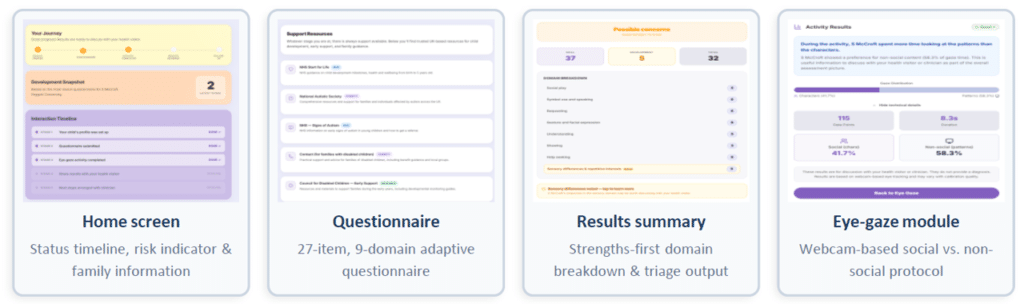
27 questions across nine areas of development including social attention, gesture, early language, sensory differences, and repetitive interests. It adapts as it goes, uses plain-English labels such as “Talking and Understanding”, and asks about a child’s strengths as well as their differences.
Eye-gaze activity
The child watches short animations while a standard webcam follows where they look, comparing their attention to social and non-social images. No specialist equipment is needed, and parents can try the activity themselves first to see exactly what it involves.
Development tracker
A play-based record of how a child’s social attention, flexibility in play, gesture, and language develop over time. It adds the context a single appointment cannot capture.
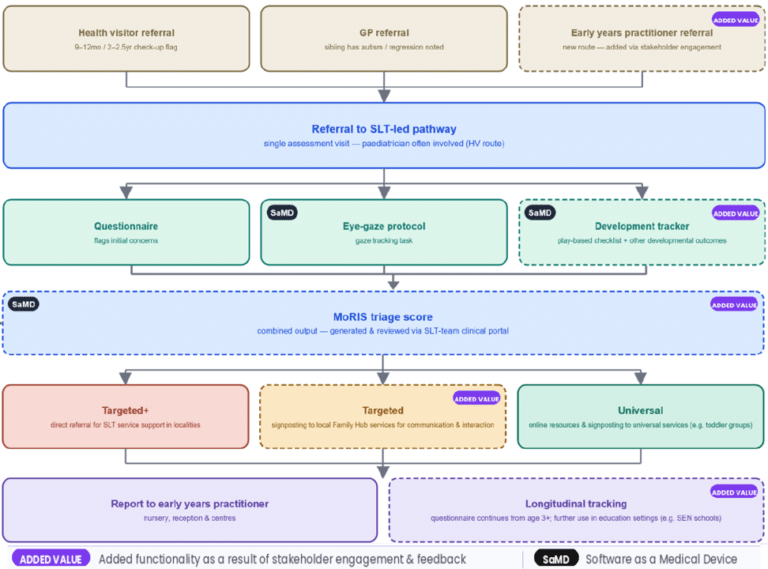
A speech and language therapist reviews the combined results in a secure clinical portal with a breakdown for each area of development, and confirms a triage score. MoRIS supports that decision. It does not make it.
A clear next step for every child
The triage score maps onto the tiers of support already used across health and education, following the Department for Education’s framework. No family is left with a result and nowhere to go.
Targeted Plus: Direct referral to local speech and language therapy services.
Targeted: Signposting to local Family Hub services which support communication and interaction.
Universal: Online resources and universal services, such as toddler groups.
Support starts while any diagnostic assessment is still under way, so children are not waiting years for the first action. With parent consent, a summary is shared with the child’s nursery or early years setting. MoRIS is also designed to follow children over time, with the questionnaire repeated from age 3 through to the end of the Foundation Stage, building a picture of how a child is developing instead of a one-off snapshot.
Built around existing pathways
Families told us that relying on parents alone to start the process risks missing children. MoRIS is designed with several ways in, so early identification does not depend on which service a family reaches first.
Health visitor reviews at 9–12 months and 2–2½ years.
GP referral, for example after a sibling’s diagnosis or a concern about a child’s development.
Nurseries and early years settings, where practitioners see children every day.
Starting school, alongside the Reception baseline.
MoRIS is designed to be delivered in a single session by a speech and language therapist (SLT) or a trained assistant with a digital training module to support them. This makes better use of senior clinicians’ time where assessment pathways are under the most pressure.
“I actually don’t feel that mistrust any more – being able to try the eye-gaze assessment helped me understand what you’re looking for and why”.
Parent
Family workshop, July 2026
Shaped by families and clinicians
MoRIS was developed with patient and public involvement led by the NIHR HealthTech Research Centre in Paediatrics and Child Health. An advisory group of parents and carers met every month throughout the project to review designs and decisions, alongside two family workshops in Sheffield and a survey of clinicians.
Discover
Built the first proof of concept and scoped the work with paediatric and speech and language therapy teams at Sheffield Children’s.
Define
A parent and carer co-design workshop and a professional survey set the priorities: where MoRIS sits in the pathway, age range, tiers, and safeguards.
Develop
Reworked the questionnaire and eye-gaze activity against feedback covering wording, usability, and personalisation.
Deliver
A second workshop where parents and a teacher tried the eye-gaze activity themselves and explored health, education, and community pathways.
Plain-English labels. Clinical terms were replaced with labels such as “Talking and Understanding”, “Sensations and Feelings”, and “Interest in Repetition”.
No number for parents. The numerical risk score was removed from the parent view because a score without context caused anxiety.
Strengths first. Positively framed questions were added to all nine areas and results lead with what a child does well.
Support straight after completing. A screen with reassurance and support links now follows the questionnaire recognising how hard assessment processes can be for families.
Guidance on each answer. Tooltips explain the frequency scale so questions are not taken too literally.
Try it first. Parents can preview the eye-gaze activity before their child takes part.
More than one way in. Health visitor, GP, and early years routes were added alongside parent-led access.
Parental instinct counts. A parent’s own level of concern is now recorded as a question in its own right.
9/10
Likelihood to adopt or recommend a validated MoRIS
Consultant Neurodevelopmental Paediatrician, professional survey
Where MoRIS is now
MoRIS has completed its proof-of-concept stage, funded by the National Institute for Health and Care Research (NIHR) through an i4i FAST award between August 2025 and July 2026. This work delivered:
A working web application with the parent questionnaire, scoring, and results summary.
A webcam-based eye-gaze module using social and non-social animations.
A clinician dashboard with a breakdown by area of development.
Early quality management documentation, as MoRIS is being developed as a Class I medical device.
In June 2026, MoRIS was selected for the NIHR HealthTech Sprint for paediatric innovations.
The next stage is to validate MoRIS against established clinical assessments, test it in real health and early years settings, and extend it into education. We will also widen our work with families to include communities which are under-represented in research, families whose first language is not English, and parents of younger children.
Screening and signposting, not diagnosis. MoRIS does not diagnose autism and does not replace a specialist assessment. It is designed to help families reach the right support sooner, while any formal assessment continues. Taking part in MoRIS does not change a child’s place on any clinical pathway.

Get involved
We would like to hear from families, clinicians, early years settings and commissioners who are interested in MoRIS or in taking part in the next stage of its development.
Follow us:

MoRIS is being developed by ELAROS with the NIHR HealthTech Research Centre in Paediatrics and Child Health and Sheffield Children’s NHS Foundation Trust.